
Don’t be afraid to speak and express yourself even when your language (especially English) isn’t strong. I’ve been around local Malaysians (especially students) and worked with a diverse group of Asian people over the years to see that many are shy to communicate their thoughts just because they are concerned with their English skills. This situation became more critical with the COVID19 Working From Home situation where communication plays a crucial role to keep all of us connected.
Many years ago, I stumbled upon a viral video “Local English or Standard English” by Marianna Pascal (one of the 50 most popular TEDx speaker in the world). Later in 2016, I am honoured to share the stage with her in TEDx Intel BayanLepas.
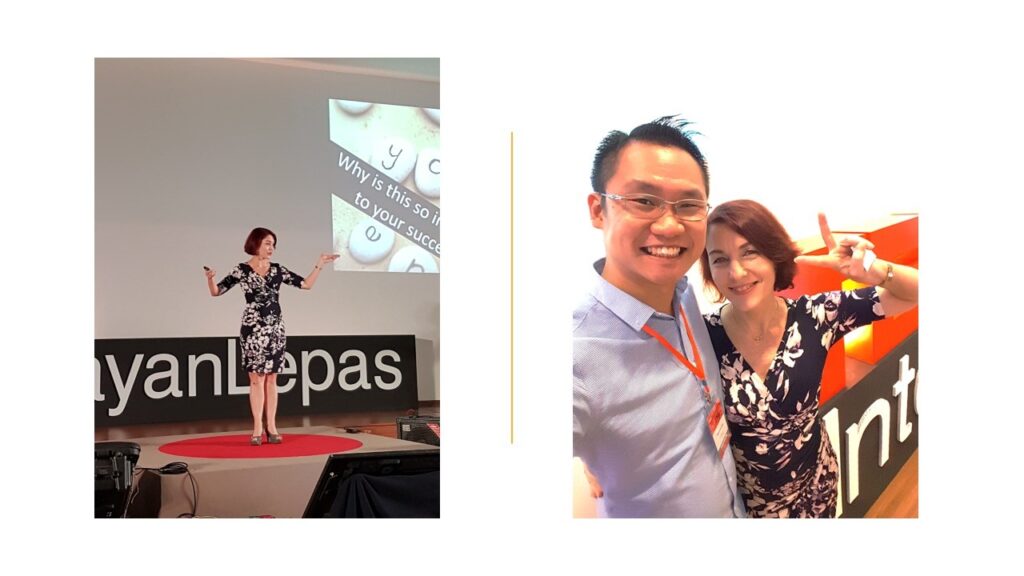
There’s a particular story by Marianna in a few of her TEDx talks that resonated with me. It is a true story about a group of Engineers having a Barbecue gathering.
Marianna’s Engineer Barbecue Story
A group of Engineers were having a Barbecue gathering and there were hot dogs (regular ones and cheesy ones) been cooked. A French engineer was cooking them and he turned to the approaching Korean engineer and asked.
“Wouldz uh you like a Hot Dog? 🌭 ” (In deep french accent)
“Oh, Yes Please” 🤗 replied the Korean engineer.
“Do you want uh the cheese?” 🧐 French engineer replied.
The Korean guy look around the table, and he doesn’t see any cheese.
“I no see any cheese 🧀 ” (in Korean accent)
“Ahh… The hot dog iz contains the cheese” 😊 French engineer explained.
Korean guy doesn’t understand him as there’s no visible cheese, showing confused expressions. 🥴 The French engineer tried harder
“No the hot dog is making from, err, with the cheese” 😥
Korean guy : 🥴
“The hot dog is coming from… no, The cheese is coming from the Hot Dog” 😓
Korean guy : 🥴
A Japanese Engineer was listening to this conversation, turned to the Korean Engineer and said
“Ah.. Cheese, Integrated” 😅
Korean Engineer understood! And everyone is now on the same page! 🎉 🥳
(Watch her TEDx Talk, link in the reference section below)
—
Recently I was reminded again on this topic; “when we communicate, at times it’s not so much on the content, but The Approach of the communication that is more important” Let’s take a step back to look at “Communication”

Experts agree that 70 – 93% of all communication is nonverbal
The bottom line is, communication means “the imparting or exchanging of information” via any means. Especially so today with the working from home.
Body Language
As we are working from home, the practice of turning on our cameras during conference calls will be beneficial. I am mindful of my sitting posture, frequently looking into the camera (not on the screen or checking myself out), using facial expression to reaffirm my points.
For me personally, Body Language speaks louder than any spoken language. We have the universal hand gestures, like “Hello” 👋 , “Am Sorry” 🙇🏻♂️ or a little salute with your head slightly bowed. Eye contacts and how you place your arms speaking to someone shows a lot in your sincerity and attentiveness. These body languages are proven to be noticed via digital presence; here’s a screenshot of the comments on a video review I did on Youtube.

Communicate via Action
With that, I would like to share another TEDx video by Simon Sinek “How great leaders inspire action”, he pointed out that “Inspired leaders and the inspired organizations, regardless of their size or industry all think, act and communicate from the inside out.”
Simon uses Apple as an example. Apple believes in challenging the standard ways (the why) by making beautifully designed products (the how) and those products just happen to be computers (the what)
Great leaders inspires not by pitching it with beautiful languages, but by their actions and doing what they believe in, even without saying anything. I believe when I am working on something, engage in a discussion and taking up a task passionately, this action can inspire others as well; all without explaining nor speaking.
Listen
Listening is an important if not, the most important part of the equation in communication. Communication is not just about us trying to push the message through, it is also how we listen, understand and send the right message across.
Especially via the digital space, in phone calls, we respond with indication in our voice/tone, “mmm” “ah!” “oh?” And on video calls, nodding in agreement with the presenter, these are non verbal communication that gives feedback to the presenter and builds a deeper connection.
Digitized Communication
As we are working from home, we are multitasking emails, chats/text messages and tasks. Although some people don’t believe in it, in digital writings; Capitalization, BOLD, underline and font size too play an important part in communication. I call them the emotions of written communication.
Some like to use emoticons and Emojis. Although it is not advisable to use that in formal communications such as official emails and corporate communications, Emojis tend to help express the “body language” without typing it out. However, use them with care to not end up with these situations : 😳 🤦🏻♂️ 😢 😱 .. Catch my drift?
As a conclusion
To become a more effective communicator, try to place other people’s needs ahead of our own during conversations. By just doing that, we will find that people tend to open up, trust us more and more knowledge will be shared across.
And keep learning… I wrote this piece of article and learned a thing or two on effective communication as well. Did some research, reached out for help and improve.
—
External reference :
https://www.youtube.com/watch?v=tQmNIqdwVMw , “Local English or Standard English” by Marianna Pascal,
https://youtu.be/Ge7c7otG2mk?t=609 Marianna on TEDx PenangRoad “Cheese Integrated”
https://www.lifesize.com/en/blog/speaking-without-words by Dustin Smith
https://www.youtube.com/watch?v=u4ZoJKF_VuA “How great leaders inspire action” by Simon Sinek